
Enhance Hospital Efficiency and Patient Care with a Cutting-Edge
Hospital Management System (HMS) – Complete Healthcare Management Software Solution
Transforming Healthcare Operations with Intelligent Hospital Management Software
A Hospital Management System (HMS) is an integrated digital healthcare platform designed to automate, streamline, and manage all clinical, administrative, financial, and operational processes within a hospital or healthcare organization.
Modern hospitals deal with increasing patient loads, complex workflows, regulatory requirements, and rising operational costs. Manual systems and disconnected software tools lead to inefficiencies, delays, and errors in patient care delivery.
A Hospital Management System solves these challenges by providing a centralized, secure, and intelligent platform that connects every department—from patient registration to discharge—into a single unified system.
It enables healthcare providers to:
- Improve patient care quality
- Reduce administrative workload
- Increase operational efficiency
- Minimize billing and reporting errors
- Enhance data security and compliance
- Enable real-time decision-making
What is a Hospital Management System?
A Hospital Management System (HMS) is a healthcare software solution that manages the complete lifecycle of hospital operations including clinical, administrative, financial, and support services.
It acts as the backbone of a hospital by integrating multiple departments such as outpatient (OPD), inpatient (IPD), pharmacy, laboratory, radiology, billing, inventory, and human resources into one system.
Core Functions of HMS
- Patient registration and management
- Appointment scheduling
- Electronic Medical Records (EMR)
- Billing and insurance processing
- Pharmacy management
- Laboratory management
- Radiology management
- Inventory control
- Staff and HR management
- Hospital reporting and analytics
Why Hospitals Need a Hospital Management System
Healthcare organizations face increasing challenges such as rising patient volumes, operational complexity, and demand for faster, more accurate services.
Without an HMS, hospitals often experience:
- Long patient waiting times
- Manual billing errors
- Duplicate patient records
- Poor coordination between departments
- Inventory mismanagement
- Lack of real-time reporting
A Hospital Management System eliminates these inefficiencies through automation and centralized data management.
Key Benefits
| Area | Improvement |
| Patient Care | Faster diagnosis and treatment |
| Administration | Reduced manual workload |
| Billing | Accurate revenue management |
| Inventory | Real-time stock control |
| Reporting | Instant analytics |
| Operations | Streamlined workflows |
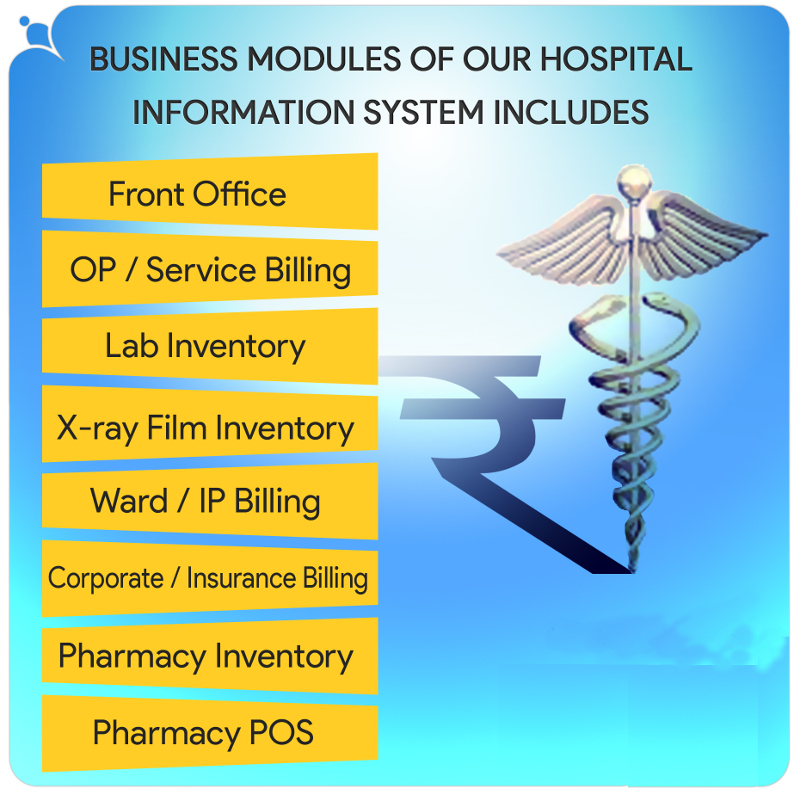
Hospital Management System Modules
- Patient Management System
Manages complete patient lifecycle from registration to discharge.
- Digital registration
- Unique patient ID
- Medical history tracking
- Demographics and records
- OPD (Outpatient Department) Management
Handles outpatient workflows efficiently.
- Appointment scheduling
- Queue management
- Doctor consultation records
- Follow-up tracking
- IPD (Inpatient Department) Management
Manages admitted patients and hospital stays.
- Bed allocation
- Admission/discharge
- Treatment tracking
- Ward management
- Electronic Medical Records (EMR)
Provides digital access to patient health data.
- Clinical notes
- Diagnosis history
- Prescriptions
- Treatment plans
- Pharmacy Management System
Controls medicine inventory and prescriptions.
- Drug inventory tracking
- Expiry management
- Prescription processing
- Supplier management
- Laboratory Management System
Manages diagnostic testing workflows.
- Test ordering
- Sample tracking
- Report generation
- Result delivery
- Radiology Management System
Handles imaging workflows.
- X-ray / MRI / CT scheduling
- Report management
- Image storage integration
- Billing & Finance Management
Automates hospital revenue operations.
- Invoice generation
- Insurance claims
- Payment tracking
- Financial reporting
- Inventory & Asset Management
Tracks hospital resources.
- Medical supplies
- Equipment tracking
- Purchase orders
- Stock alerts
- HR & Staff Management
Manages hospital workforce.
- Staff scheduling
- Attendance tracking
- Payroll
- Performance management
Hospital Management System Workflow
A typical HMS workflow follows this process:
This ensures:
- Smooth patient flow
- Reduced waiting time
- Faster treatment cycles
- Accurate recordkeeping
Types of Hospital Management Systems
Cloud-Based HMS
- Accessible from anywhere
- Lower maintenance cost
- Scalable and flexible
- Automatic updates
On-Premise HMS
- Full data control
- Higher security customization
- Internal hosting
Most modern healthcare providers prefer cloud-based HMS due to scalability and ease of access.
HMS vs EMR vs EHR
| Feature | HMS | EMR | EHR |
| Hospital Operations | ✔ | ✖ | ✖ |
| Clinical Records | ✔ | ✔ | ✔ |
| Billing System | ✔ | ✖ | ✖ |
| Inventory | ✔ | ✖ | ✖ |
| Multi-department Workflow | ✔ | Limited | Limited |
HMS is a complete hospital operating system, while EMR/EHR focus mainly on patient records.
Industry Use Cases of HMS
Multi-Specialty Hospitals
Manages full hospital operations across departments.
Small Clinics
Handles appointments, billing, and patient records.
Diagnostic Centers
Manages test scheduling and reporting.
Specialty Hospitals
Used in dental, eye, fertility, and orthopedic centers.
Integration Capabilities
A modern HMS integrates with:
- Electronic Health Record systems
- Electronic Medical Record systems
- Laboratory Information Systems (LIS)
- Radiology Information Systems (RIS)
- Insurance providers
- Payment gateways
- SMS/Email systems
- Telemedicine platforms
Healthcare Compliance & Security
A Hospital Management System ensures strict healthcare data protection and compliance:
- Role-based access control
- Data encryption
- Audit logs
- Secure backups
- User authentication
It also supports compliance with healthcare standards such as:
- NABH
- Healthcare data protection guidelines
- International interoperability standards like HL7 and FHIR
Benefits of Hospital Management System
Clinical Benefits
- Better diagnosis accuracy
- Faster treatment decisions
- Complete patient history access
Operational Benefits
- Reduced paperwork
- Automated workflows
- Improved coordination
Financial Benefits
- Reduced billing errors
- Faster revenue cycles
- Better cost control
Strategic Benefits
- Data-driven decisions
- Improved hospital efficiency
- Better patient satisfaction
Hospital Management System Implementation Process
Step 1: Requirement Analysis
Understand hospital workflows and needs.
Step 2: System Configuration
Customize modules and workflows.
Step 3: Data Migration
Transfer patient and operational data.
Step 4: Staff Training
Train hospital staff for adoption.
Step 5: Go-Live Support
System deployment and monitoring.
ROI of Hospital Management System
Hospitals implementing HMS typically experience:
- 30–60% reduction in administrative workload
- 25–40% faster billing cycles
- Reduced patient waiting time
- Lower operational costs
- Improved resource utilization
Why Choose Avanttec Hospital Management System
Avanttec offers a comprehensive HMS solution designed for modern healthcare organizations.
Key Advantages
- Fully integrated hospital platform
- Scalable architecture for all hospital sizes
- Real-time reporting and analytics
- Secure and compliant system design
- Customizable workflows
- Strong implementation support
Future of Hospital Management Systems
The future of healthcare is digital and data-driven.
Key trends include:
- Artificial Intelligence in diagnostics
- Predictive healthcare analytics
- Mobile-first hospital systems
- Telemedicine integration
- Cloud-based healthcare ecosystems
- IoT-enabled hospital devices
How to Choose the Right HMS
Before selecting a system, evaluate:
- Scalability
- Security features
- Integration capability
- Ease of use
- Vendor support
- Cost of ownership
Frequently Asked Questions (FAQs)
What is a Hospital Management System?
A software system that manages hospital operations, including patient care, billing, and administration.
What are the benefits of HMS?
Improved efficiency, better patient care, reduced costs, and accurate reporting.
Is HMS suitable for small hospitals?
Yes, it can be scaled for clinics and small healthcare centers.
Does HMS support billing and insurance?
Yes, it automates billing and insurance claim processing.
Can HMS integrate with lab systems?
Yes, it integrates with laboratory and radiology systems.
Is cloud-based HMS better?
Yes, it offers scalability, remote access, and lower infrastructure costs.
What is the difference between HMS and EMR?
HMS manages full hospital operations, while EMR focuses on patient records.
Is HMS secure?
Yes, it uses encryption, access control, and audit logs.
A Hospital Management System is the foundation of modern healthcare transformation. It connects clinical, administrative, and financial operations into a unified digital ecosystem that improves efficiency, enhances patient care, and supports better decision-making.
By implementing a robust HMS, healthcare organizations can achieve operational excellence, reduce costs, and deliver superior patient experiences in an increasingly digital healthcare environment.